Nebraska Veterinary Diagnostic Center
Contact the NVDC prior to tissue collection or sample submission at 402-472-1434.
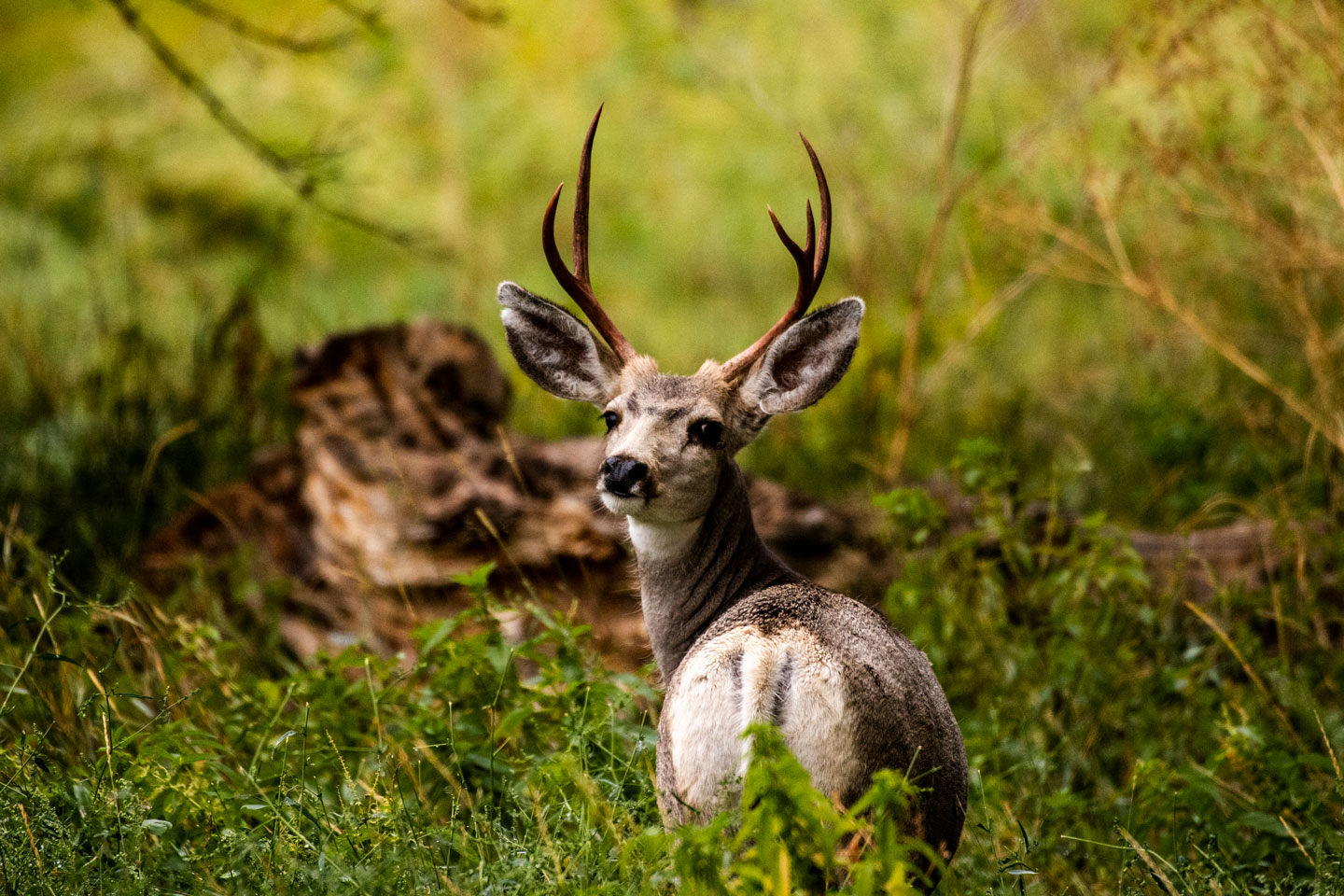
Chronic Wasting Disease is a prion disease that attacks the brain of infected deer, elk and moose.
Chronic Wasting Disease (CWD) is a disease caused by misfolded proteins, or prions, that can spread directly from animal-to-animal contact, indirectly through environmental contamination or materials, and potentially vertically from mother to offspring. Animals are able to shed the infectious prions through their bodily fluids. Because prions are extremely resistant to typical sanitation processes, they can persist in the landscape for a long time. CWD is a progressive neurological disease and is always fatal. Symptoms progress slowly within an infected animal, and many animals are killed before symptoms can appear. Symptomatic animals may appear emaciated, exhibit a loss of awareness, and lose fear of humans.
While CWD has not been reported in humans, it is related to another prion disease, bovine spongiform encephalopathy, which can cause variant Creutzfeldt-Jakob Disease in humans, according to the Centers for Disease Control and Prevention. For this reason, public health officials recommend taking precautions when handling or processing a harvest or tools used during the butchering process. They also recommend avoiding consumption of meat from deer and elk that look sick or that test positive for CWD.
CWD was first discovered in Colorado in 1967 and in Nebraska in 2000 in Kimball County. Since 1997, the Nebraska Game and Parks Commission has tested over 58,800 deer and over 400 elk, with CWD being detected in 1,549 deer and 23 elk to date. At this time, CWD has been detected in free-ranging deer and elk in 68 counties.
In 2025, Game and Parks had 809 hunter harvested deer samples. Of those, CWD was detected in 204 deer, with three new counties being added to the detection list (Logan, Kearney, and Nuckolls counties). More in-depth information on CWD can be found on the CWD Alliance website.
The map below shows the Nebraska counties and Deer Management Units where CWD has been detected.

Deer season CWD test results from the past five years can be searched in the application link below. Tests were conducted by Nebraska Veterinary Diagnostic Laboratory (NVDL).
Elk season testing results from the Nebraska Veterinary Diagnostic Laboratory (NVDL) can be viewed below.
Learn the answers to the most frequently asked questions about CWD.
Weight loss, poor body condition, increased urination, drooping ears, drooling, difficulty swallowing, wheezing or breathing abnormalities.
If you see a deer exhibiting signs of CWD, report it to your local Game and Parks office, or to the Wildlife Health email [email protected] with the location, date, time, number of deer affected, and any other information you can provide.
CWD can be transmitted directly from animal-to-animal contact, indirectly through environmental contamination or materials, and potentially vertically from mother to offspring. Animals that are crowded or confined have a greater chance of encountering the body fluids of other animals and, therefore, a higher likelihood of becoming infected if CWD prions are present.
Surveillance occurs on a rotating basis across the state’s deer management units. Our surveillance plan for the 2026-2027 season is currently in development. The deer management units in which surveillance will be conducted will be announced later in the year.
In 2025, lymph node samples were collected from harvested deer to be tested for CWD during the firearm season in the Buffalo, Platte, Frenchman, and Republican units.
Submissions are voluntary from hunters, and Nebraska Game and Parks staff will collect and pay for testing of samples collected from deer harvested within the designated surveillance DMUs each year.
Hunters outside of the designated surveillance units can submit samples through their local veterinarian or to the Nebraska Veterinary Diagnostic Center, Kansas State Veterinary Diagnostic Lab or Wyoming State Veterinary Lab at the hunter’s expense.
Testing continues throughout the year for suspect sick deer and elk.
Participation in the CWD surveillance program is optional. Hunters in the four designated Deer Management Units can opt in to have their deer tested at no cost to them by requesting a mail-in kit or having their sample taken at a local check station.
Clinical signs of CWD alone are not conclusive, and there is currently no practical live animal test. Currently, the only conclusive diagnosis involves an examination of the brain, tonsils or lymph nodes performed after death. Research is being conducted to develop live-animal diagnostic tests for CWD.
If a deer tests positive for CWD, Game and Parks staff will notify the hunter using the contact information associated with the hunter’s permit account. Hunters can view their test results by clicking “Look up deer CWD results” under the CWD testing results deer tab within their account in the permit system. Results may take 3-6 weeks.
Nebraska Game and Parks does not reissue tags for harvested deer that test positive for CWD.
The Centers for Disease Control and World Health Organization recommend avoiding consumption of meat from deer and elk that look sick or that test positive for CWD.
Public health officials recommend that human exposure to the CWD infectious agent be avoided as they continue to evaluate any potential health risk.
People should remain cautious in how they handle, process, and consume deer. Hunters and commercial processors should avoid butchering or processing of deer that spreads spinal cord or brain tissue to meat or to the environment.
For questions related to human health, contact the Nebraska Department of Health and Human Services or visit the CDC website.
Learn how to properly field dress and debone your harvest through a video series created by the Chronic Wasting Disease Alliance.
The Nebraska Veterinary Diagnostic Center, Kansas State Veterinary Diagnostic Lab and the Wyoming State Veterinary Laboratory all will test deer for CWD. Hunters also can contact their local veterinarian for assistance.
Test results may take up to 6-8 weeks and times will vary depending on the volume of samples submitted. Hunters should keep this in mind if test results are desired before processing deer.
Contact the NVDC prior to tissue collection or sample submission at 402-472-1434.
Contact the KSVDL for sample submission information at 866-512-5650 or
[email protected].
Contact the lab for sample submission information at (307) 766-9925 or [email protected].
If you remove the skull cap with antlers attached, the saw should be cleaned and disinfected with a 50/50 solution of chlorine bleach and water. This saw should not be used to cut through any edible portions of meat on the carcass.
If you keep the entire skull (for a European mount), you should insure all flesh and soft tissue, including brain matter, is removed. Wear rubber or latex gloves while doing this, and clean the skull by soaking it in a 50/50 solution of chlorine bleach and water.
A number of states have adopted regulations affecting the transportation of hunter-harvested deer and elk. Since the suspected infective agent (prion) is concentrated in the brain, spinal cord and lymph glands, the most common regulation is the prohibition of the importation of whole carcasses harvested from CWD areas.
Generally, states that have adopted carcass transportation regulations do not allow importation of any brain or spinal column tissue, but allow processed/wrapped meat, quarters (with no spinal column or head), hides, clean antlers/skull plates with no meat or tissue attached, finished taxidermy.
Since regulations are continually evolving, it is recommended that you check the CWD regulations in your state before hunting. A summary of state-by-state carcass transportation regulations may be accessed through this interactive map.
CWD poses serious problems for wildlife managers, and the implications for free-ranging deer and elk are significant. While some impacts of CWD on population dynamics of deer and elk are still being researched, studies show CWD has the potential to substantially reduce infected deer or elk populations by lowering adult survival rates and destabilizing long-term population dynamics.
Find additional information from the Centers for Disease Control and Protection on Chronic Wasting Disease:
The Nebraska Game and Parks disease management efforts are focused on:
Hunting permits
Purchase hunting, big game and turkey permits, as well as supertags and combo lotteries.
About Nebraska Game & Parks
We’re a family of passionate, innovative professionals who work together to connect people to the natural world and support conservation in Nebraska.